Wednesday, March 28, 2007

Los Tres Concert

Last Wednesday night I went to a concert here in Chillán by the Chilean rock group Los Tres. They have been around since the 80's, but really hit their stride in the 90's after the Pinochet dictadura was peacefully overthrown. I just recently discovered their music and bought their latest CD. I was really surprised to see that they were playing in Chillán, since we are pretty far from the mainstream down here and good concerts are few and far between.

On the night of the concert I arrived at the Casa del Deporte a few minutes before the scheduled 9:00 pm starting time, ticket in hand. The line at the door stretched around the corner, so I wandered along its length to the end. As soon as I took my place at the end of the line, a young substitute teacher from school, Orlando, came up and motioned to me to come with him. He and another young teacher, Nelson, were farther up in the line. Although we hadn't really had time to get to know each other in the first few weeks of school, they recognized me and took me under their wing.

Once inside, I realized that I might be the oldest person in the building. There must have been 3-4000 university students seated in the wooden bleachers of the aging gym. As soon as the band started, everyone started singing. And I mean everyone, and every song. It was remarkable. I have mentioned before my impression of Chilean parties, where one person starts to play the guitar and everyone starts to sing along. This concert was no different, except that there were several thousand people at this party. The crowd swayed, there arms aloft in gentle waves, as the band played. Occasionally they would all hold up their cell phones, the lighted dials replacing the bic lighters of concerts of yester-year.

The crowd was incredible, and the band was awesome. Los Tres can really rock. They played for about an hour and a half, then left the stage. The crowd started clapping for an encore, and then started chanting in unison, one example being "no nos vamos sin miramos" (loosely translated: we are not leaving without seeing you). This encore solicitation went on for about 15 minutes, and the chants kept changing, but the volume remained constant, and eventually the band came back and played for another 45 minutes!

It was all quite splendid. Great music, great crowd, great energy.

Here is an MP3 of my favorite Los Tres song, Hagalo Usted Mismo (do it yourself), which tells the story of a conversation between God and a guy with woman problems.


Here is a link to a good Wikipedia article on Los Tres.

Friday, March 23, 2007

These shoes are made for walking

When I first arrived at my school last July I received two white board markers and an eraser. Oh wow, I thought….tech support is alive and well here in Chillán. It was months later when I discovered that the eraser was actually meant to polish my shoes. Meanwhile, I brought it home (since I discovered an eraser in each of my ten classrooms) to use on our own white board, purchased after a vast search in all the office supply stores in Chillan. White boards and the like are still a foreign concept here in Chile. Also noteworthy, Post-it Notes, a can’t-live-without staple at home, are nowhere to be found here.

So, back to the walking. We don’t own a car here. School is about a mile or more from our house and we get there by foot. I’ve only taken a taxi twice since last July due to blustery conditions. There are days when I walk to school, walk home for lunch, then back to school, then home again. All in all, probably equal to the miles I walk many a day in Portland to air out my thoughts and take in the lush ambiance.

Like any professional, I arrived last July with all the right clothes for teaching, including a pair of Italian leather J Crew boots I bought on sale 10 years ago and had yet to break in. True confessions—I had never worn them. Always the pragmatist, I guessed that Chile might be the perfect opportunity to get some mileage out of these boots. Many blisters later those boots are now well broken in.

Still, as spring progressed, my feet were aching for more freedom. Our school follows a fairly strict dress code, so I watched with an eagle eye for a change in footwear. I was a bit uptight since all the women at my school tend to wear high heels, far too fancy and dangerous for my needs. Caramba! I often marveled at how my colleagues could balance on pinpoint spikes while walking to the farthest point on campus—ours, the senior building. I, on the other hand, could barely navigate the crowds with flats. Anyway, well aware that some dress codes dictate no open-toed shoes, I didn’t want to be the first to break the rules so I consulted with the experts: my students. While they acknowledged that exposed toes are not the norm, they also encouraged me to disregard conformity because, in their words, I was exempt as a norteamericana. Eventually, I saw my first open-toed sandals on the feet of a colleague in November…and pulled out all the stops after that.

I must have been a victim of foot binding in a past life. Now that the school year has resumed, I suppose it’s time to dress professionally again, which means chucking the Reefs. They indeed look like they’ve been scraped and scrabbled by some vicious reefs. Nonetheless, they are deliciously comfortable. My solution for now is to leave my work shoes in my locker at school and wear my walking shoes, or flip flops, to and fro. Even this is an oddity and I feel like I have to change my shoes in the privacy of the bathroom to avoid gaping stares. Students make comments about my footwear when I’m in transit. Now I can put Rodrigo’s comments about my desire to ride a bike to school in context—scandalous he said. This is an insider’s view of “correct” teacher behavior in our school.

I never did put my Limpia Calzado (shoe cleaner) to its intended use, but it makes a perfect eraser for our white board at home. Rest assured, I do have a wide array of shoe polish and wax, and diligently keep my school shoes sparkling. So does Dan, however he has been wearing his Crocs to school these days and I sense a whole new scandal is about to erupt.

As for all the ground we’ve covered, we are making considerable inroads on the senderos (trails) of Chile. Now that we’re back in school we are limited to weekends when we continue to explore this gorgeous country. Fortunately, we live close to the Andes and have easy access to many sacred sites, always a treat for trekkers like us. Our shoes are well worn and have a permanent home here in Chile, not to return back to the USA, but rather to the earth on which they tread.

Monday, March 19, 2007

Vendimia Festival

Last Saturday we went to a vendimia festival to celebrate the fall grape harvest. The festival was in the tiny town of Rahuil, which is in the coastal mountains between Chillán and Concepción. We went with Pam, our friend and fellow Fulbrighter here in Chillán, and she in turn was the guest of Don Jorge, the principal of the K-8 school in Rahuil. Pam had donated some books to the school the week before, and Jorge had invited her to come back and be part of the vendimia.

We started off the morning by driving west on paved roads for about an hour, then turned on to a dirt road in the small town of Rafael. We were headed for the school in Rahuil, where we were supposed to find some people who could tell us the way to the actual festival. Pam had been as far as the school once before, but luckily we picked up a couple of young hitchhikers who helped us find the way among the many branches of the dirt roads. We got to the school alright, but there was no one there. Our cell phones couldn't pick up a signal out there, and the phone booth at the school didn't work either. So, we kept driving, stopping to ask directions from a couple of farmers in their field, and at one point waited for 10 minutes at a crossroads for a car to come by. The people in that car knew exactly where to go, and they told us to follow them. Sure enough, after 15 minutes and a couple of obscure turns onto increasingly narrow and rutted roads, we arrived at the Rahuil community soccer field where the festival was just getting going. (I admit at this point I was wondering how we were ever going to find our way out of there and back to the main road...but hey, this is Chile, so I figured it would all work out. Worse case, we sit at a confusing fork in the road until someone comes by and ask directions.)

A large tent had been set up, and maybe a hundred people were listening to a traditional music group and cueca dancers. We met Don Jorge and his wife Patricia and their kids, and felt warmly welcomed. Pam was asked to say a few words into the microphone and also do a brief interview for a television film crew that was there. Although we were clearly the outsiders in this small town fiesta, we felt welcomed and accepted.


Soon, most of the crowd, including us, headed out of the tent and up into the nearest vineyard, lugging wooden boxes to pick grapes. Along with us was a ox cart with a large wooden half-barrel. Everyone was picking grapes (and eating them too) and dumping their boxes into the cart. The vines in the vineyards around there were low to the ground and growing close together. The contrast with the laser-straight manicured vineyards of the large industrial wineries in much of Chile was striking. I felt like we were seeing the way grapes have traditionally been grown by small towns for centuries. This was, as they say in Chile, campo campo, the real countryside.

Within 30 minutes or so the cart was full and the crowd made its way back to the tent for lunch. Also at this time large green jugs of chicha, a mildly-fermented freshly-pressed grape juice similar to apple cider, was making the rounds. It was quite delicious, and I'm guessing that people have been drinking some form of chicha around the world as long as they have been harvesting grapes, going back thousands of years.

After lunch we rested for awhile in the shade of a nearby grove of pine trees (it was over 90 degrees in the sun by that time). After about an hour, the festivities started up again. Another large half-barrel had been set up under the tent, and across the top of the barrel were slats of bamboo. The idea was to crush the grapes with your feet so that the juice would drop through the slats into the barrel. Actually, there was a contest to see which team of two people could do the stomping with the most style. With dance music blaring through the speakers, the contestants held on to ropes overhead to steady themselves while dancing a merry jig on the grapes. The crowd applauded their efforts heartily. Below is a video of the winning team.


Note, if the embedded video doesn't work for you, try this link

Around 5:00 we decided to leave with Douglas and Marisol to catch a ride to Concepción where we could catch the bus back to Chillán. Before leaving I bought a 2 liter plastic bottle of chicha being sold from the back of a pickup truck in the parking lot. The woman selling it warned me to release the pressure inside periodically or the whole bottle might explode. On the ride back on the bus I found myself carefully untwisting the bottle top slightly to allow a hisssss of pressure to release. Back home in Chillán, sitting in our refrigerator, the chicha has continued to get a little stronger each day as the fermentation proceeds. Each sip takes me back to the festival and connects me to the ancient history of harvest festivals, and especially to the grape harvest festivals. I feel like we could have been in an ancient Greek valley in 400 BC and it wouldn't have been too different from what we experienced in Chile in 2007. It was a timeless combination of the grape harvest, small-town neighbors, good food and drink, music, and laughter. Gracias a la vida.

To see more photos of the day, click on this link

Sunday, March 04, 2007

Kayaking in Parque Pumalín

In the first week of February, we took a kayaking trip through the fjords of Parque Pumalín in southern Chile. We gathered a group of seven friends and enlisted the guiding services of Alsur Expeditions. The trip was fantastic, although it was not without its moments of discomfort and stress. Before we could get our boats in the water, we had to first take a 10 hour bus ride from Chillán to Puerto Varas in a bus with broken air conditioning on a day when the temperature must have been hovering around 90 degress. It was brutal. Every hour or so we would pull into the bus terminal in another town where we would have 5 minutes to rush to the bathroom and back before the bus took off again. Another fun part of the bus trip was that when we got close to Puerto Varas they dropped us off out on the freeway outside of town rather than taking us into the center of town to the bus station. Luckily there was another person who got off at the same spot who helped us flag down a local bus to take the 10 minute ride into town.

We stayed at a nice hostel in Puerto Varas and assembled our group: Dan and Catherine, plus Shay and Stephen, our friends from Portland who were here in Chile for vacation. Also, Pancho, Catherine's cousin from New York, and Douglas, the husband of another Fulbright teacher in Concepción this year. Finally, Annie, a Fulbright teacher living on Robinson Crusoe Island off the coast of Chile.

Monday morning, our guide Tomás and a driver picked us up and we drove south for about 3-4 hours, in the rain, to get to Hornopirén, where we would put the boats in the water. There we also met our support boat and crew, Rudi and Beto. For one reason or another, we didn't actually get the kayaks into the water until about 5:00 pm, and we had several hours of paddling before nightfall, including a rather dicey channel crossing in wind and rain, our group rather spread out and only one guide to keep track of us all. The conditions were rough, and Pancho had never kayaked before, and Annie's boat was leaking and sinking low in the stern, drastically slowing her down. (We later patched the leak with duct tape.) Luckily, our destination was a hot springs on the island of Llancahue where we got to soak in the hot pool and spend the night in real beds in the hostel rather than camping out in tents.

I awoke several times during the night, each time hearing the rain coming down hard, and each time I turned over and thought, "ah, it will stop by morning...". Well, the next morning as we set out the rain was still coming down. Let me tell you, there is nothing quite as spirit-dampning as putting on cold, wet, paddling clothes. Hmmmm, maybe this wasn't such a good idea after all.

As we paddled that morning, the rain eventually stopped, but it was still pretty cold and cloudy. The spirits of the group remained high. It was great to be out on the water, invigorating. We joked with each other quite a bit, and the humor was of a decidedly dark variety ("terrible. no, horrible, that's what this is"), but no one whined! As the clouds began to lift we were able to see more and more of the incredible fjords all around us. The discomfort ceased to be an issue, and we surrendered to the beauty and the challenge of the day. Midday, we met up with Ludwig, the head guide, who had been detained on another trip and couldn't make it for the first day of our trip. After lunch, we continued paddling, pausing briefly to get up close and personal with a group of sea lions.

Eventually we arrived at the hot springs at end of the Cahuelmo fjord and set up camp. What an amazing place, with the hot tubs chisled out of solid rock, with natural hot spring water flowing in through channels in the surface of the rock. It was glorious, and we spent several hours in the water, warming our bones and cheering our spirits. This was one of the most beautiful spots that I have ever visited, yet the caretakers there said that they actually get very few visitors during a summer. Perhaps the cold and rain and the complete absence of a road contribute to this. Beto, our support boat crewman, was born and raised on the shores of this fjord, but the family homestead is long gone, abandoned and absorbed back into the rain forest. One troubling aspect of this place is the pending possibility that a road will be built along the coast to connect northern and southern Chile. There is a major fight going on right now in Chile over the placement of that road. If the road is built, this area will be completely changed.

That night in our tents at Cahuelmo, we again listened to the rain, but by morning it was only cloudy. We meant to get an early start, but slept in a little too late and ended up having a tricky exit as the tide dropped further and further, threatening to strand us in the mud flats. We had another day of paddling, with an afternoon of brisk winds and tricky waves. By about 4:00 pm we were glad to climb out of our kayaks and get on board the support boat to make the final channel crossing to Porcelana Creek and its hot springs deep in the forest. We spent two nights camping here, and enjoyed the hot springs morning and night. It was here that my sleeping bag ripped open in the middle of the night and we woke up in the morning with a tent full of feathers. We also took a hike one day to visit and tour the beekeeping and honey producing farm that is part of Parque Pumalín.


I could go on and describe each subsequent day of paddling and the wonders that we saw. But in truth, the memories that are most happily recalled to my mind are of the people on the trip. Rain or shine, the people sparkled. The memories of mountains and the waters and the birds and fish fade away, but the people remain in my heart and mind. Here are a few impressions of the members of our group:

  • Our head guide Ludwig, who shared his long experience in the area and tested us frequently with politically incorrect humor. He also showed us the proper way to drink mate.
  • Our guide Tomás, to whom we taught the proper use of the phrase, "bummer", and in more extreme conditions, "BUMMER, dude".
  • Rudi, the captain of our support boat, a man of few words but impeccable judgment and knowledge of the sea. Also his son, Rudi Jr., who we could see taking over the controls of the boat occasionally with his father close by.
  • Beto, the crewman of the support boat, who was always cheerful and always seemed to anticipate what needed to be done. Love those white boots, Beto.
  • Carmen, who conjured three gourmet meals a day in the support boat's tiny galley and always went to the hot springs with us as well. The most memorable meal may have been the seafood stew made with mussels harvested that morning off the rocks, along with fresh caught salmon.
  • Pancho, the ultimate sun-worshipper, did he ever stop smiling, even when the rain was pouring? Also notable, his statement that he only has two speeds for paddling, "slow and frantic"
  • Douglas, seemed like the quiet type, until he started telling jokes. I will never forget the joke about the three construction workers and their lunches.
  • Annie, kept us all in stitches, and translated our jokes into Spanish
  • Shay, the energizer bunny of paddling, she just keeps on going.
  • Stephen, whose positive outlook and good common sense kept us on an even keel even when the waves of discontent threatened to swamp the boats
  • Catherine, who makes it easy to keep in sync while paddling together in the double kayak, and in life as well

In the end, as I look back on my travels through life, it is the people that I remember rather than the places.

To see more photos of the kayak trip, go to http://www.slowtrain.placo.com/photos/kayakpumalin/

To see a GoogleMaps map of some of the places from our trip, go to
Dan and Catherine's annotated map of Chile

Thursday, March 01, 2007

La leña seca

Some of you might remember a previous posting in this blog about wet firewood at the end of last winter. Not wanting to repeat that particular predicament, I stocked up on wood this summer when the price was low and when the wood would have plenty of time to be really dry before the cold weather arrives in the next couple of months. Live and learn. I hope I got enough.

Friday, January 26, 2007

Por fin! Enladrillado

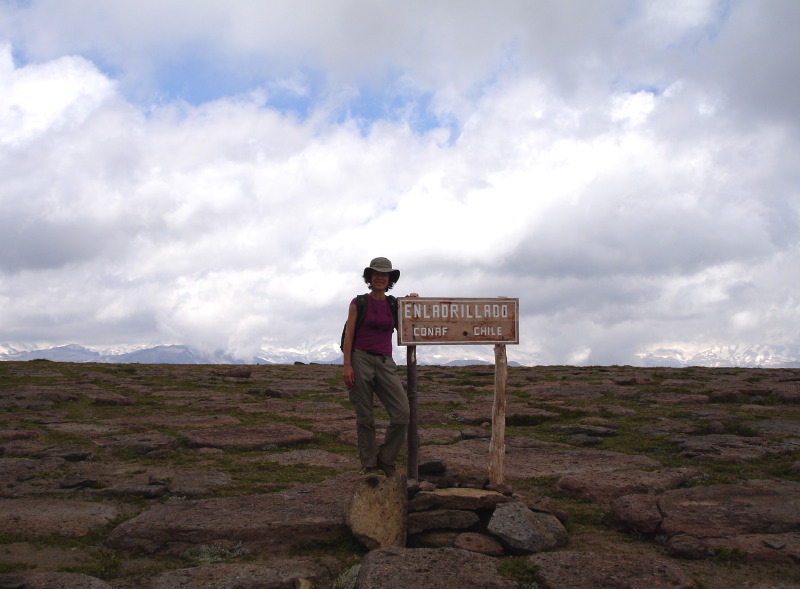
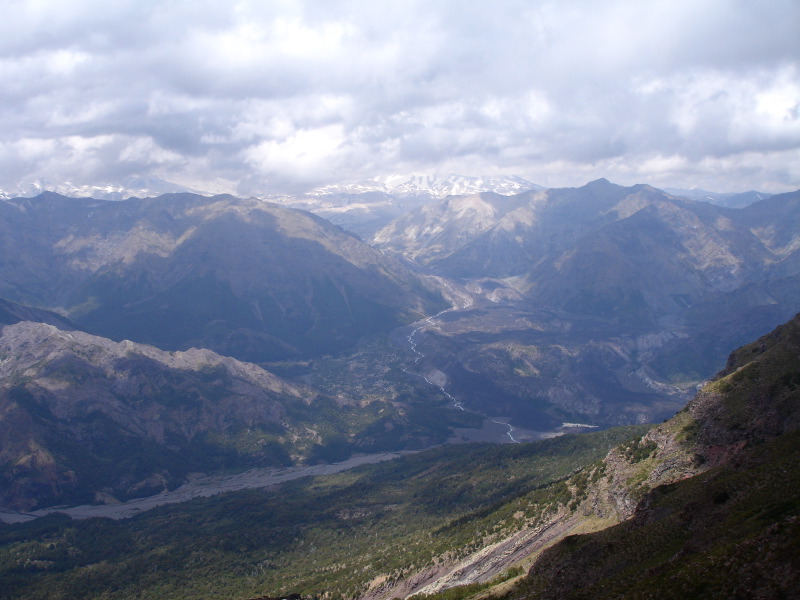
Yesterday Dan and I hiked to Enladrillado, loosely translated as “brick paving”, a plateau in the Andes that overlooks the Claro gorge. The name is attributed to the layout of stones on this high plain: gigantic hexagonal stones that appear to be tiled by a mysterious landscape artist in the sky at an altitude of 7,160 feet. Among locals it has a reputation for being a UFO landing strip. Even the Chile Corporacion Nacional Forestal (CONAF) map refers to the popular interpretation of the site as designed and visited by extraterrestrials. This has been a destination since we knew we were coming to Chile and we read about it in guide books…not because of the woo woo factor, but because it’s considered to be the most beautiful hike between Santiago and Temuco—our home territory here.

After four hours of steadfast hiking and climbing we reached Enladrillado and noticed one other friendly person who paused for a warm welcome before resuming his gesturing to two other companions off in the distance. We sat on a large flat rock perched on the precipice of the Rio Claro valley far, far below and took in the breathtaking views of the mountain peaks and the valley landscape while eating our lunch. “Blissed out” best describes our state of mind. Eventually, after consuming every last morsel of our food while absorbing the vast vistas, I noticed a new buzzing sound. I turned to see the trio sitting in a tight circle, chanting in unison. We were delighted that they were not intimated by our presence and could readily launch into such exuberant harmony. We listened to their rising and falling cadences and wondered about their invocations. Eventually though, they were forgotten as we retreated into our own wondrous world.

Just as our fingers were getting numb and we thought we should start moving again, a magnificent condor appeared to the east and gracefully glided above us. Dan hustled to take a photo but that meant taking his eyes off this majestic bird with a wingspan of 10 feet. It was, in a word, magical. As it faded into the western sky, our friends, finished with their meditation, were whooping with joy at the condor sighting. They came over to tell us that there were only 50 condors in Chile and it was very special to see one. We have no doubt about the latter—it was more than special, it was spectacular. After a few moments of celebration and then a photo-op for Dan and me, they were off.

In time we began to gather ourselves to resume the walk back down to the Rio Lircay valley floor. After lingering for our last long look, we turned to go back. Within minutes Dan shouted an alarm behind me and I swung around to see that the condor was back. This time he was determined to capture its grandeur in a photo because our memories often fail us in the long run. The condor mesmerized us with its presence and kept us a captive audience for a while longer. All good things come to an end however, and ultimately we had to bid farewell to the King of the Andes as it disappeared from where it came in the eastern horizon. We’re unanimous on this: a visitation from aliens is not required to make this trek worthy of its high rating; on the other hand, a visitation from a condor elevates it to the sublime.

For more pictures from the hike, go to this link

Wednesday, January 17, 2007

English Summer Town -- Chilean Style

Upon arriving in Chile last July and during our orientation, we Fulbright teachers signed a contract with Chile Fulbright cementing our commitment to teach at English Summer Town in January 2007. Ah, they caught us early in the honeymoon stage—speaking for myself here, I later wondered why I didn’t notice that EST was during my summer vacation—January and February. The new school year starts around March 1st.

As my teaching year began to wind down in December the reality of preparing for English Summer Town seemed a little daunting. Like at home, when June rolls around I’m ready for a break from the daily demands of teaching. I didn’t relish the thought of teaching for a week in January. Fantasies of lolling in a hammock seemed to eclipse everything else and I was having an all-out war with my motivation. In the end professionalism and commitment won out.

We arrived at Las Colinas de Cuncumen http://www.cuncumen.cl/ccm/index2.htm on Sunday the 7th and were instantly enamored of the setting, a gorgeous retreat center SW of Santiago. Wow! We realized that the English Open Doors Program and the Chilean Ministry of Education, along with Chile Fulbright, made a gargantuan effort to provide us with the best that Chile has to offer—an aesthetic environment with delicious traditional Chilean food.

The U.S. Fulbright teachers were the main event in EST: http://www.ingles.mineduc.cl We taught English language acquisition strategies to Chilean English teachers during the morning sessions and our family members taught cultural workshops after lunch. My morning sessions focused on writing strategies; Dan taught American folk songs in the afternoon.

When we first arrived to Cuncumen I was slightly shocked by how remote we were, with no internet access and spotty cell phone reception. The nearest town with services was about 45 minutes away. I needn’t have worried about being cut off from the world for a week-- we created our own vibrant universe there. The week turned out to be fabulous. Each day found us engaged in thoughtful conversations, rousing discussions, soulful songs and lots of playful activities. Obviously, we weren’t the only ones to interrupt our summer vacation: 120 Chilean teachers gave up a week of their summer break to attend EST as well. Once the buses rolled in with all the Chilean teachers on Sunday evening we knew we were in for a rocking week.

Here are some of the high points:

  • Attending the workshops of my U.S. colleagues and learning new strategies to teach English in Chile. Furthermore, we had the opportunity to deepen our connections during the week. Lifelong friendships are coalescing among us.
  • Collaborating with our Chilean colleagues who were passionate participants in our sessions all week. I was rejuvenated by their energy, creativity, and insights about teaching. At the week’s end my toolbox for teaching English doubled thanks to their many generous suggestions and ideas.
  • The dance contest in which Dan was a finalist. He credits his dance partner, Anita, but he’s being too humble. They were an impressive couple and undoubtedly someone out there has photos or even a video of their fancy step-work.
  • The rally squad “yell-off” in which Terri really tore it up with some hot, hot moves. I don’t need a video to recall that performance—it’s indelible in my memory! Her team won the cheering competition by the way.
  • The spontaneous singing and dancing from our Chilean colleagues at any given moment. The picture of Hector on Dan’s blog entry was taken after lunch one afternoon when we were all gathered in the dining room-- a collective expression of gratitude for our week together. Songs were sung, dances were danced, and a fun time was had by all.
  • The cloning awards in which people were bequeathed with certificates for looking like a carbon copy of someone else. Among us we had Shakira, Michele Bachelet, and Don Quixote to name a few. In the past Dan has been mistaken for Rick Bayless and we were once treated like royalty in a posh Mexican restaurant for that misconception. He is accused of looking like Harvey (a gringo character in a Chilean soup opera), John Denver, and Bruce Cockburn among others. I have been with him when people have asked, “Are you famous?” He has that look about him which once again earned him focused attention. He was our Don Quixote.
  • My keynote speech on Thursday. The topic was Teachers and Students Taking Risks. I wrote an essay about the potency of teachers modeling risk taking and life-long learning. Initially I was intimidated because my predecessors had power point presentations, prizes to give away, and were very entertaining to boot. During a dip in my confidence I remembered my topic and the fact that I was asking teachers to risk sharing their writing in my morning workshops. Life imitates art imitates life.

I left Cuncumen Friday afternoon knowing that I didn’t give up anything to be a part of English Summer Town. I gained a whole new perspective on what it means to be a Fulbright teacher here in Chile.

Tuesday, January 16, 2007

How to play the cueca

Last week I accompanied Catherine and the other Fullbright teachers to English Summer Town, an event where about 100 Chilean teachers of English gathered for a week of workshops on how to teach English. My small role in all this was to present a couple of afternoon workshops on 'American Folk Songs'.

On the first day, I was sitting outside the dining room after lunch, playing the guitar, hoping to drum up some interest in my workshop that afternoon. Right away, I met Hector, (photo to the left), who asked me to play Country Roads, by John Denver. "I don't know any John Denver songs," I grumbled, (a long-held prejudice of mine dating back to my teenage years and being told too many times that I looked just like the syrupy folk singer, but that is another story). Undaunted by my grumpiness, Hector suggested "Feelings", or maybe anything by Kenny Rogers. I was starting to get really worried, imagining a long week of singing "You got to know when to hold 'em, know when to fold 'em..."

However, my first afternoon workshop was totally fun, the participants engaged and singing along with all the songs. I was surprised at how many of the songs, like Oh Susanna, they already knew. As I have experienced before in Chile, the love of music and singing is widespread among the people here. Along with the singing, we had some great discussions of the history and politics surrounding the songs, supported by Terri's great research and comments. As the workshop was breaking up, a couple of the participants asked if I could play any Chilean songs. Well, I do know Te Recuerdo Amanda. So I played it, and they sang along, and then they grabbed pencil and paper and made a list of 5 more songs that I should learn. I was beginning to see that I was going to learn much more than I was going to teach this week.

The next day I was not scheduled to present any workshops, but during lunch we started singing Beatles songs at our table, and after I left the table, Catherine made an appointment for me with the other teachers at the table for an informal music session under the trees later that afternoon. Only 4 or 5 people showed up, but they were great, and we went through the folk songs from the workshop. At one point, one of the teachers, on the right in this picture, picked up a couple of rocks and began to beat out the rhythm.

On Wednesday evening, I was feeling tired around 10:30, so I wandered back to our cabin for some quiet time to catch up on my reading. Catherine was hanging out with the other Fullbright teachers, catching up with their collective experiences in Chile. Around 11:00, Catherine and Hector came to the cabin, looking for "Danny!". Hector wanted to borrow my guitar and asked if I wanted to come play some music. I was so settled-in that I declined, but gladly lent him my guitar. Soon, I could hear the sounds of singing drifting up the hill from the other cabins. I lasted about 20 minutes, and then said to Catherine, who was drifting off to sleep at this point, that I had to get up and see what was going on down there.

As I felt my way down the hill in the dark, the group called my name and launched into a rousing version of 'Feelings', full of gusto and good humor. I was hooked. At the center was Hector, playing the guitar and fielding requests. Surrounding him were about 20 Chilean teachers, and Bill, the husband of another Fullbrighter, and me. It seemed that all the Chileans knew all the songs. The singing was enthusiastic and heartfelt, and it went on and on, the wellspring of shared songs so deep here in Chile. At some point I was asked to sing a few, and Hector and I traded back a forth for a bit (although he is a much better player than me). A high point for me might have been the duet we sang of Juan sin Tierra, by Victor Jara. Bill and I, as the only gringos in the crowd, kept looking at each other and trying to imagine a similar collection of songs at a party in the USA that everyone would know and sing. I should mention that all of this was happening without any alcohol, fueled solely by the love of the music and shared culture.

I finally gave into fatigue at around 2:00 am (not sure really, didn't have a watch) and stumbled back to bed, but sleep would not come easily, my heart and mind were so stimulated by the outpouring of joy and sadness of the songs. It was humbling to be with those teachers, to swim in the deep waters of their music, to see how they sang with the hearts as well as their voices. I was learning so much more than I was teaching.

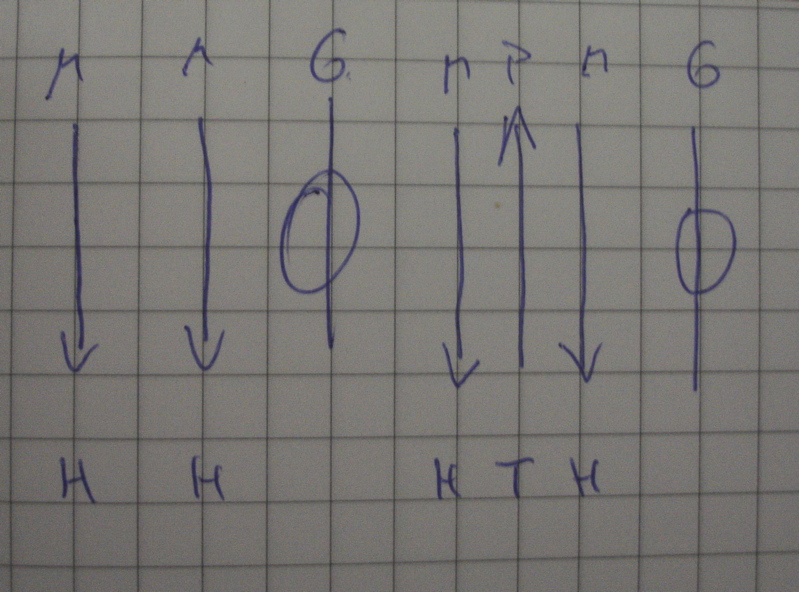
Finally, to wrap this up since it is going on longer than I really planned, on the last morning I ended up eating breakfast at a table with Hector. We were talking about the guitar, and I admitted that I just could not master the rhythm of the Chilean national dance, the cueca, on the guitar. Hector admitted that he, likewise, could not get the feel for the rhythm of the blues. We arranged to meet just before lunch, and Hector would teach me the secret to the cuecu, and I would show him what I knew of the blues. To the left you can see the simple sheet that Hector gave me to explain the rhythm of the cueca, 1-2-3, 1-and-2-3. What a master guitarist he was, and what a master teacher. I ended the week feeling that I had received so much more than I had given. As Violeta Parra sang, 'gracias a la vida, que me ha dado tanto'

Wednesday, January 03, 2007

2007: In with the old, out with the new

Last year (wow, we can say that already?) was a year of monumental change for us…lots of new experiences inside and outside of our comfort zone, along with some bona fide challenges that will make us tougher and more resilient in the end – according to current day psychobabble. We’re still crafting our New Year’s resolutions. Here they stand at the moment: carve out a daily slot to speak Spanish-only together; do more yoga; don’t perseverate about things that are out of my locus of control (me); acknowledge that each day is a new beginning; tranquilo because we can’t change anything about Chilean bureaucracy; embrace the Chilean educational system for what it is (in other words, don’t worry so much about being super-teachers, revel in the relationships that we’re forging); and count our lucky stars for being in this magnificently beautiful country.

But come on! We would love a little predictability in our lives. As estadounideneses, we are planners. It’s a deeply ingrained trait for us. As a teacher I map out my curriculum for the school year before it starts! It goes without saying that the Portland Public Schools calendar is available in March for the following school year in September. Here in Chile we’re currently on summer break and the school year is supposed to start up on March 1st or somewhere thereabouts. I have no idea about my schedule—what it looks like, which classes I’m teaching, and worst of all, when the school year starts. This is torture for me I might add. Perhaps I should add spontaneity to my list of resolutions?

All that aside, we are hoping for fewer surprises and more forays into known territory. For example, we want to continue to build upon our Spanish language acquisition, a precious gift for both of us. Translation: we hope to encounter more Chileans who are patient enough to let us stammer through our conversations and respond in kind or better, in naturally spoken Spanish. So far our encounters, for the most part, have been very nurturing and thereby lowering the affective filter –educational lingo for making the learning environment welcoming and eradicating the fear factor. (We’re always making fools of ourselves, but who else is taking note?). Additionally, it would be pure bliss to know when I’m required to return to school and what’s expected of me (and us, since Dan is teaching some of my classes as well, lightening the load of 400+ students a week).

We’re hoping to continue the community building vibe in our neighborhood and in Chillán in general. It goes without saying that we’re starting over with new students in the Fall (March), yet we would like to think that we’re making progress with navigating the Chilean way of being. We hope to establish long-term relationships that result in a continued exchange with our Chilean friends upon our departure. Oh my god, I’m already talking about the future and leaving—a totally un-natural perspective. I do not want to think that far ahead. Be here now is a glorious New Year’s resolution.


For more pictures of our family gathering over the holidays, click this link

Monday, December 25, 2006

Hiking in Parque Altos de Lircay

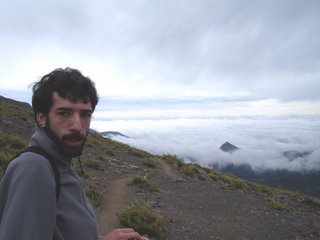
On the weekend before Christmas we went hiking with Kumar in Parque Altos de Lircay, east of Talca and near the town of Vilches. The weather was cool and cloudy, threatening to rain by evening, but we had a great hike, seeing lots of tarantula-like spiders along the trail and eventually climbing above tree line and above the clouds, opening up towering vistas of the Andes off to the east.

We had the trail mostly to ourselves since almost everyone else was at home preparing for the holiday. For us, it seemed that the best way to prepare for Christmas was to be outdoors with our family, enjoying the natural beauty of Chile.

To see more pictures, click this LINK

Wednesday, November 22, 2006

All in a Day

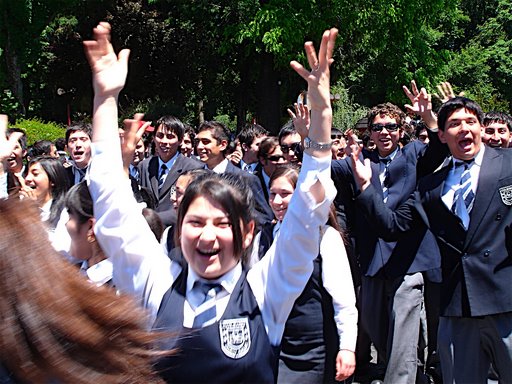
Saturday morning started out with a Dario Salas parade en el centro to celebrate our schools’ (four in all) anniversary — 80 years as a corporation and 25 years in education. When I asked the exact date I was told all of November. And so it is…we’ve been celebrating in one form or another for weeks. CDS takes school spirit to its zenith. Students have been collecting bottles caps since September 25th — chapitas y tapas de bebidas o jugos de Coca Cola — competing between classes for the most caps, between the four colegios, and between other secondary schools in the country. I don’t know our status yet….I just wish I had taken photos of the garbage barrels overflowing with bottle caps accumulated by Cuarto Medio alone, the senior class. Other activities include elections of a king and a queen for each grade level, a poetry and composition contest, art exhibitions, singing contests, dance contests, and sports events. The culminating event, la Fiesta de Coronación, is on November 29th. Life at school might seem rather ho hum after this. Fortunately, the school year ends for students on December 14th.

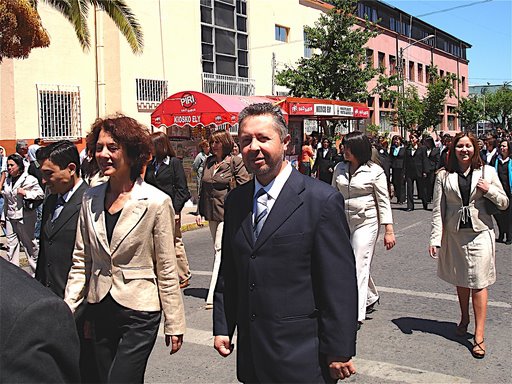
Well back to the parade, composed of staff and students and cheered on by the community of parents, students who didn’t want to be on duty on a Saturday, and other CDS supporters. I was told to be at the Plaza de Armas at 11 am, so I showed up at 11:45 (finally getting the hang of Chilean time) with plenty of time to socialize, laugh, and set a lighthearted tone. Our school was first in the line up that extended five blocks behind us, which we were all grateful for because the sun was brutal. Once the parade commenced our practice session in precision marching was forgotten by all as we slipped into an easy stroll, barely able to keep our horizontal rows intact. We marched for 100 meters before we reached the end of our route. The parade coincided beautifully with an aerial show performance that began minutes earlier. It looked made to order.

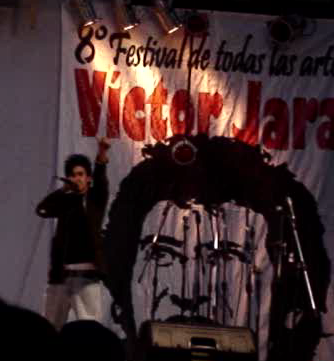
Afterwards Dan and I went home to change and go on to the Victor Jara Arts Festival which promised poetry readings, a photography exhibit, and lots of great music. Victor Jara is a Chilean folksinger and left-wing political activist who was tortured and murdered in the Stadium days after the September 11, 1973 military coup. We count ourselves among his fans. When we mentioned to our colleagues that we were going to the festival, one in particular said that we’d encounter the Partido Comunista there. The prospects for meeting some of Chillán’s lefties really appealed to us. Alas, when we arrived we found ourselves surrounded by hoards of youth dressed in black. First we felt old, then redeemed when we spotted grey hair among the crowd gathering in front of the stage. We were just too early - a common refrain - so we left for a while, but not before some of the same CDS students who were marching in uniform earlier that day flagged us down. They too went home to change and were wearing drab clothes and sporting their Fidel Castro caps. We exchanged polite greetings and all of us tried (unsuccessfully) to hide our surprise at the encounter.

When we returned a few hours later the music was just about to begin. Fortunately a friend saved us seats because there were none to be had otherwise. And yeah, the crowd was multi-generational, from the elderly in wheel chairs to the pre-kinder set. We learned that the guest of honor was the Cuban Ambassador. He and his party were ushered into the VIP area with lots of fanfare. Soon we were grooving with the music, which, like the audience, was the full spectrum of diversity. When one of my students came on stage with the energy of a jet engine I almost fell off my chair. He appeared to be levitating while singing a rap version of Victor Jara’s Manifesto. Wow! In that moment I saw him in a new light. In school he’s the poster boy for disaffected youth…usually late for class, sneering when his face is visible, otherwise presenting the top of his head with spiked and gnarly hair, down on his desk. Everything about him screams I don’t want to be here. We videoed his performance and I gave him the CD on Monday at school...he was grateful and pleased that we appreciated his talent. He explained that he’s not doing a practicum or going on to college after he graduates in December; he’s moving to Santiago to find his way there. I wish him luck.

Additional highlights included students from other classes who sought us out to say hello and informed us that they would be playing later on in the evening. We stayed until 11 pm and missed them — the festival went on until 3 am. Here’s an excerpt from Manifesto:

Yo no canto por cantar
ni por tener buena voz
canto porque la guitarra
tiene sentido y razón
tiene corazón de tierra

I don't sing for love of singing
or to show off my voice
but for the statements
made by my honest guitar
for its heart is of earth

Wednesday, November 15, 2006

Hola, vecino

We have been living here in Villa Naval, a neighborhood in Chillán, for about four months now. During that time the neighbors have been, well, a bit cautious. Not unfriendly but not overly friendly either. There have been a few exceptions, like the next-door neighbor and the woman across the street, who have always said hello and engaged in some small talk, but in general we felt like outsiders, which we were. A big part of this is obviously due to our limited (but improving) Spanish language skills but another part may be the cultural norms in Chile when it comes to strangers in the neighborhood. Add in a bunch of really cold and rainy weather during our first few months here and you have a recipe for isolation.

Then on Monday this week I came home in the afternoon to find that there was no power in the house. No lights, no internet, no nothing. I went outside and asked a couple of neighbors, "do you have power?"

"Yes," they said, "did you pay your bill?"

"I think I paid the bill..."

Well, actually, I don't pay the electric bill directly. We pay the rent, which includes a fixed amount for utilities, to Rodrigo and he pays the electric bill automatically through his bank. Or so we all thought. It turns out that there was a misunderstanding, un malentendido. Due to an error somewhere in the chain (no finger pointing here) no one has been paying the bill for the last four months. So on Monday, the power company came out in their little truck, climbed up the pole, and disconnected our power line. This public display of humiliation was witnessed by all the neighbors and they all knew that it meant we were delinquent.

Oddly enough, this episode has broken the ice. Neighbors that have never even said hello to me before now stop me in the street and ask me if I got the power turned back on (which I did, later on that same afternoon, after a few confusing phone calls. I met Luz Maria down at the power company office and paid off the bill, which caused the same truck to show up a couple of hours later, and the guy climbed up the pole and reconnected our line). Somehow, we aren't outsiders anymore, or at least less so.

This all crystallized for me yesterday when I was walking back to the house and passed a woman and her young child with whom I had exchanged polite holas, but nothing more, for months, and she said to me, "hola, vecino." Howdy, neighbor. I feel like we have arrived.

Sunday, November 12, 2006

For the Love of Music

I have had several musical experiences this week that I'd like to recount. The first one came about because I am using music quite a bit in my duties as a part-time English teacher here in Chillán. Last week I was using the Hammer Song, written by Pete Seeger and Lee Hays in 1949. At the time it was written it was considered quite radical and controversial because the Hammer was a thinly-veiled reference to the hammer and sickle of the USSR's flag. In class, I was comparing the original song to the translation made by the Chilean Victor Jara in 1969, talking about the differences in the situations within the US in 1949 and Chile in 1969. I thought it was a pretty successful lesson, so I started looking for another song to use for the next week. I have been wanting to use Bob Dylan's The Times They are a Changin', so I began to look for a Spanish language version of that song. I eventually found one by a group called Los Young Beats, a Columbian garage band from 1966. Their one CD has been re-issued on a German label, Break-a-way Records. I wrote to the email address on the web site and asked if they could make an MP3 of that one song available to me, telling them of my planned use and saying that I'd gladly pay for it. Within an hour, I heard back from Wolgang, who said he couldn't do the MP3, but he would send me the disk, airmail, for free. He said it would be a pleasure to help out. Wolgang, you rock!

A second thing happened today. Yesterday Mauricio was working on our roof to fix a leak. We were gone most of the day, so he came back today to collect his pay. While we were talking, he noticed my guitar and asked if I played. Sure, I said, how about you. Yeah. So I asked him to play something, and he launched into several beautiful songs, playing quite well and singing with a wonderful soulful voice. Then I played my one Chilean song, Te Recuerdo Amanda, and he sang right along, an impromptu duet in the living room, connecting across country and language differences.

Finally, all day long today our neighbors next door, with whom we share a thin duplex wall, have been playing one song over and over and over again at high volume. At first I kind of enjoyed it. It is a song I vaguely know from the radio and it is kinda catchy, plus it was fun to hear the kids next door singing along with it. But, after 4 or 5 hours and many, many repetitions, Catherine and I began looking at each other and saying, "for the love of god, give it a REST!"

And just now at 9:00 pm on a Sunday night as I write this, right on cue, that song just started up again next door for the umpteenth time. What the...oh well, for the love of music...

You can listen to Pete Seeger singing the Hammer Song here:


And you can listen to Victor Jara singing his version here:

Sunday, October 29, 2006

Love Fest

Given the location of the reception, the wedding crowd included invited guests and anyone who happened to be staying at the residencia that weekend. Here is Gina, a student from San Diego State studying abroad in Uruguay. She was there that weekend visiting her friend Travis, another SDSU student studying in Valparaíso who lives here.

While we were chatting in the courtyard another person kept trying to catch my eye. Every time I looked up he was smiling and attempting to engage me in conversation. Eventually, we found each other and he introduced himself as Gonzalo from Iquique. He was bubbling over with enthusiasm because 1) this was his first time in Valparaíso; 2) he was marveling at his good fortune to have chosen a place to stay where a wedding with fabulous people, food, and spirits just happened to be part of the amenities; and 3) he recognized Dan and me from the bus the night before. Apparently we all took the same bus from Santiago. Gonzalo had been in Santiago arranging for his visa to study at UCSB - Santa Barbara. He was very animated when explaining his upcoming venture to the US. Additionally, he was intrigued by the fact that the three of us shared the same bus and once again, we were sharing an event, in this case, rather highly-charged and potent given the context. “It’s crazy” he emphatically exclaimed over and over with evangelical zeal. He wondered-- how can this be? What could possibly be the meaning? Is there something in the cosmos that guided the three of us, or all of us for that matter, to be in the same place at the same time?

I have no easy answers other than my belief that there are no accidents. We were all meant to be together at Teresa and Nigel’s wedding. If there’s anything cosmic about this communion, it’s this: We witnessed the union and wedding vows of two very open, generous, authentic, beautiful people. They are committed to forge a new life together—and to manifest a vision of weaving their family and friends into a strong community that holds at its center a reverence for taking care of each other. This is what Teresa and Nigel represent to me--an open arms welcome with no holds barred. So, por supuesto Gonzalo, it is as it should be. We are all drawn here by the magnetic force of abundant love.

Wedding in Valparaiso

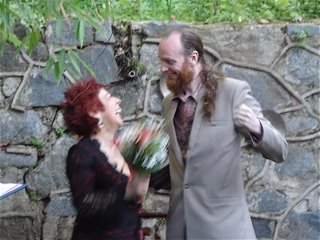
Last weekend we traveled back to Valparaiso to attend the wedding of Teresa and Nigel. Teresa was the host mom for Sarah when she lived in Chile in 2001, so there is a special connection between our families. Teresa is a Chilean who lived in exile in Denmark for 20 years, and Nigel is from Northern Ireland. Together they run an Irish bar in Valparaiso.

We arrived in Valpo around 9:00 pm on Friday, after traveling all afternoon by train from Chillán to Santiago, and then another 2 hours by bus to Valparaiso. We got settled in our small hotel and then headed out to grab a bite to eat. We ended up in a small place a block or so away through the winding streets of the hills of Valparaiso. There were two young men working the cafe, and just a few other patrons. We settled in to our meal, and they settled back into their card game at a table at the back of the room. At one point I asked the waiter about the intriguing music that was coming over the speakers...Los Fabulosos Cadillacs, he said, un grupo argentino. Cool. Later, as we were paying the bill and getting up to leave, he gave us a CD with MP3s of all Los Fabulosos Cadillacs albums. What can I say? This is Chile. The generosity of the people here sometimes just makes me smile.

The next day we just hung out and wandered around Valparaiso, trying to save our energy for the wedding that night. Around 5:00 we grabbed a cab and headed over to the wedding, which was being held at a beautiful old Valpo house that has been converted into a youth hostel. We weren't sure what it meant when the invitation said 5:00 pm, but as it turns out when we got there at 5:15 there were just a few people around, but luckily, since Nigel is an Irishman, after all, there was a keg of beer already tapped. Between then and 6:00 more and more people arrived, and then Teresa arrived and the actual wedding began. The crowd was bohemian and international: Lots of Chilenos, of course, with Catherine and I the only US representives, and others from France and Ireland and Germany, and Nigel's best man, Dave, from England, plus a band of Columbians playing traditional Irish music. Also, Teresa's family, sisters, brother, her children, and her mother were all very much in attendence.


The wedding ceremony itself was very sweet, with loving testimonials from both Nigel and Teresa. Teresa's son Liber stood at her side and offered support and English translation as needed. After the exchange of vows and rings, the real party began. The sound system was cranked up and everyone started dancing. And I mean everyone. It didn't matter if the music was Santana, or funky Ric James, or traditional Cueca, everyone was dancing, young and old. The dancing went on for several hours, with much drinking and a pause for speeches by Teresa's siblings and Nigel's best man (hysterically translated from English to Spanish by Nigel himself, a low-res video of which can been seen here here),

At around 10:00 pm, the word quickly spread that the food had arrived. The guests fell on the buffet like a pack of wolves on a fallen caribou. All the enthusiasm that was shown for the wedding vows and the dancing was now transferred to the food. Ah, the exhuberance for life that we find here in Chile! After the food, more dancing! At about 11:30, we were over-stimulated and fading, but the party showed no sign of slowing down, so we silently took our leave and headed back to the hotel, about a 20 minute walk. Who knows, the party may have gone on till the wee hours of the next morning. As for us, we had to get up the next morning and grab the 10:00 bus to Santiago and then the train back to Chillán, our ears still ringing from the dance music and our hearts still overflowing with the shared love of the wedding party.

A few photos from the wedding can be seen here

Thursday, October 12, 2006

One Meatball

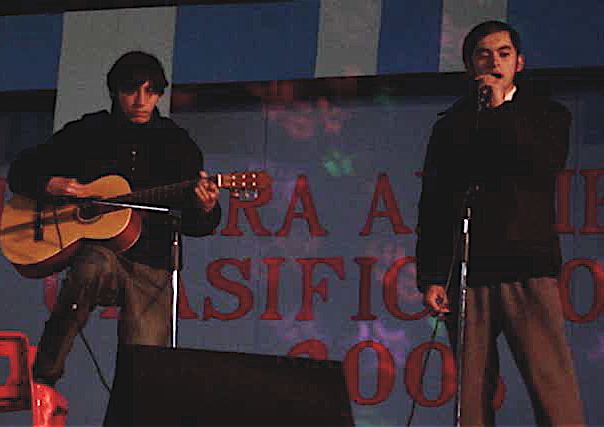
Here is one of my students who I affectionately call Mr. Ramone because he fancies himself as one of them. He’s performing at our school assembly de cantantes today. About fifteen of my seniors, some in pairs and some solo, bravely got up in front of a rowdy audience and belted out a song or two. If that’s not exciting enough, Dan was the headliner, making his concert debut with lots of fanfare. He opened the event with Victor Jara’s Te Recuerdo Amanda and yet again stirred emotions with his beautiful rendition. He followed with One Meatball after an elegant introduction in Spanish about its significance of scarcity and poverty during the depression era.

Meanwhile, I’m riding high on waves of appreciation and admiration for the talent and courage of today’s artists, Dan included. As I witnessed my students standing on the stage baring their souls I was struck by how multifaceted they are. I have to preface all of this by saying that there are days when my enthusiasm wanes considerably. Teaching 400 seniors in their last months of high school doesn’t always bring out their best attributes—or mine for that matter. Senioritis reigns. When Gustavo is ignoring me and bobbing his head to his mp3 player, Luis is stonewalling me with “no entiendo inglés”, Carolina has her cosmetic accoutrements strewn all over her desk and is curling her eyelashes with that scary looking contraption, and Maria is ignoring the spilled perfume pooling all over her desk and soaking her assignments--- ahhh, let’s just say that it takes a will of steel to refrain from grabbing my backpack and departing with “hasta luego”. And I’m being kind here. This honest –to-goodness scene is hardly the worst of it.

Yet I glimpsed the best of it today. It was a One Meatball moment! My current epiphany is that I’m being served a full course meal this year in Chile and sometimes I reduce my experience with my students to one meatball. I only see a small part of who they are--often just minor details in the complex collage of their beings. Some of my challenging students performed this morning and exposed their veracity for life and love. It is a poignant reminder to avoid the myopia of one meatball and to consume the entire feast offered to me.

Here’s the link to a video of Dan singing

Tuesday, October 10, 2006

Siete Tazas

We just got back from a three-day weekend. Catherine and Pam and I headed northward about two hours to Casa Chueca, a beautiful little cabaña situated in the countryside just outside the town of Talca. Casa Chueca is run by a German couple who also run a lot of outdoor camping treks in Chile. Most of the other guests were also German, some on holiday and others living and working in Chile. The setting was lovely and it was great to get away from the noise and exhaust of city life for a couple of days.

We arrived on Saturday afternoon, hung around for a while, and then headed into Talca for a late lunch. We ended up at an unassuming place along the river that had great food, and lots of it. The place was really crowded when we arrived, but thinned out as we ate since we arrived at the tail end of the lunch time. By the time we finished we were so full that we didn't even think about dinner later.

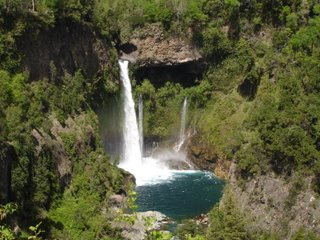
On Sunday we hired a driver for the day to take us to Siete Tazas, a forested national park with famous waterfalls. The drive there took over two hours, mostly on dirt roads, and we saw almost no other cars, so we figured that we would have the place to ourselves. Wrong! When we finally got to the national park, it was actually very active with lots of people camping out with tents and barbeque grills. We are finding that the Chileans love to get out into the country, and this three-day weekend, with spring weather finally here, really brought them out. We're all in this together.

But the crowds weren't so bad, and we spent several pleasant hours hiking and sitting by the river and the falls. Eventually we made our way back to the trailhead and made the long drive back to Casa Chueca. That night we ate dinner at the hotel, served family style at one big table with the other guests, with conversations in German, Spanish, and English swirling all around.

On Monday, we woke up with big plans to rent bikes and go riding, but as it turned out we spent most of the morning reading in hammocks in the shade, which was just what we needed. We arrived back in Chillán Monday night refreshed and ready to charge ahead with activities in the coming weeks.

More photos of the weekend can be seen at this link.

Tuesday, September 26, 2006

Valparaiso

Last weekend we took a trip up to Valparaiso to celebrate our tenth wedding anniversary and also to visit with Teresa and Nigel. What a great city, and what a great way to start our next decade together. We walked the hills and narrow streets, ate our first non-Chilean food in two months (Indian), and tried to relax and enjoy the spring sunshine. Teresa and Nigel were wonderful hosts, and we plan on returning to Valpo next month for their wedding.

To see more photos of the weekend, click here.

Monday, September 25, 2006

The poet in the marketplace

This morning I was listening to the radio in the kitchen, which is part of my usual routine, when I heard the deep sonorous voice of Pablo Neruda, his slow oceanic rhythms breathing phrases in and out, instantly recognizable. I was stunned. They're playing tapes of Neruda on the radio. Is Chile a great country, or what?

But wait, listen to the words more carefully, the poem is talking about taking digital photographs, and now the spell is broken and I realize that this is all a hoax, and that it was a Neruda impersonator and this is a commercial! They have hijacked the voice and spirit of Don Pablo for the dirty business of selling! What an outrage. What kind of country is this?

But wait, think again. Try to imagine which poet's voice would be instantly recognizable in the USA, so that such a trick could even be attempted. Alan Ginsberg? Billy Collins? Robert Frost? Here in Chile, it seems to me that everyone would immediately know that the voice in the commercial was supposed to be Neruda, and the conceit, wink, wink, knudge, knudge, of using the voice of a communist poet to sell stuff would have a certain cheeky resonance. In the USA, there is no such single shared literary awareness on which to base the joke.

What a great country is Chile!

You can listen to the commercial here:


Better yet, you can listen to the real Neruda reading Love Poem #20, recorded in Washington, DC in 1966, Note the obvious similarity of the lines in the commercial to the initial lines of this poem.

More Fiestas Patrias

During the Fiestas Patrias celebrations last week, we were lucky enough to be invited to two family gatherings. The first one, on Saturday night, was at the house of Maria Angelica, who is an English teacher at Catherine's school. At her house we met her husband and two kids, her mother and father, her three sisters, a nephew, and a couple of other friends. Early in the evening, I ended up outside with the other men, tending the barbeque and chatting. This was really good practice for my Spanish, and the talk ranged from charcoal to meat to futbol to wine, and then suddenly we were talking about the poetry of Pablo Neruda, and then about the music of Victor Jara and how he was so brutally murdered by Pinochet's troops during the coup in 1973. I was moved by the deep sense of culture and history that lurks so close to the social surface here in Chile.

At one point during dinner the nephew asked me if I liked McDonalds, and I, of course, protested strongly that I hated McDonalds, bahhh! There was a pregnant silence at the table, and then I learned that his mother, Maria Angélica's sister, who was sitting across from me, works at McDonalds. DOH!!!! Why can't I learn to be a little more diplomatic? But, then the discussion deepened, and the questions turned to why did I not like McDonalds. Was it the food? Was it the politics of big business? (Obviously it wasn't because I was a vegetarian because I had just polished off a big plateful of grilled meat.) In the end I think I was forgiven and I confessed that I do sometimes indulge a craving for McDonalds french fries.
Unfortunately I forgot my camera that night so there are no photos.

On the last day of the four-day weekend during Fiestas Patrias, we were invited to a gathering at the house of Omar, another one of Catherine's colleagues. He lives out in the country, about 25 km east of Chillán. It was a beautiful spring day and it felt good to get out into the countryside and breathe the fresh air. As the afternoon progressed, more and more friends and family arrived. There were games, lots of asados, a horse to ride, and, of course, music and dancing. There were a couple of guitars there and several people took turns playing and singing. I even sang the one chilean folk song I know, Te Recuerdo Amanda, and I guess it was good enough since everyone sang along, and then demanded an encore performance later when more guests had arrived. It was a relaxing afternoon spent in good company with warm and fun-loving people. We felt welcomed and accepted.

More photos can be seen by clicking this link
A short video of the singing is here

Sunday, September 17, 2006

Fiestas Patrias

September 11th marked the beginning of Fiesta Patrias week – the celebration of Chile’s independence from Spain – culminating on September 18th. Our July 4th is tame in comparison and from what I can tell, these are the high holidays of the year. This is a family centered time that reminds me of Thanksgiving. Long standing traditions define this holiday and include making empanadas, asados (barbecues), playing Chilean folk music and most important, dancing the Cueca. The Cueca is the national dance of Chile that takes center stage this week. It’s a courtship dance that evokes the mating ritual of hens and roosters. The dancers wave a handkerchief and use it skillfully to be coy, clever, and above all, creative.


Here we have my fourth period class on Monday. They came prepared to teach me the Cueca and launch the week in grand style. By midweek all classrooms were decorated for Dieciocho.


On Wednesday we had a huge fiesta with the seniors. Each grade level had their own celebration. Students all chipped in and helped with the food prep (asados) and organization. We had a Cueca dancing competition between classes (there are 12 in all). Dan and I got to be judges which I didn’t especially find fun because they were all winners. Here we have Romina and Nataly from an all girls class who adapted the Cueca beautifully. They got high scores for charisma and afiatamiento pareja –strong partnership. They eventually took third place. Notice the smoke in the background, testimonial to all the feasting to follow.

Yasmin and Rodrigo in traditional dress—as are many of the students in the background. We saw scores of students wearing these outfits all over Chillán this week. They ranged from pre-K to high school students. I’m trying to imagine my students in Portland embracing folkloric traditions in a similar way and then going public. Somehow the picture is not taking shape.

We’ve all danced, feasted, laughed, and hugged. Here is the winning couple with some of their classmates. The collective enthusiasm is amazing to witness—not only with students, but with colleagues as well. After students left for home on Friday afternoon the staff had our own party with empanadas and dancing. Despite having several Cueca lessons this week, Dan and I didn’t have the confidence to dance until the music changed to salsa. Now that’s what I’m talking about.


Here are two Cueca videos. See if you can figure out the dance steps:

Stephanie and Luis--second place

the three finalists

More photos of cueca dancing at Dario Salas can be seen here

Monday, September 11, 2006

Nine Eleven

The earth is shivering
will she sneeze?
Suddenly without warning
buildings crashing down
horror undammed
gushing forth in violent rushes
while we desperately search for life jackets
floating devices in an unlikely event

My how we’ve changed
Homeland Security
for the hidden evil
that lies within us?
No No
you are misguided
wayward preachers of fear

We remain as true as the moon
facing forward
with a hand reaching backward
Hold my hand
tie the strand
knit the soul strings into a blanket of solidarity
warmth is ours when we embrace our true goodness

Thursday, September 07, 2006

la leña mojada

Last night, with the return of the full moon, I realized that I have been in Chile for four weeks now. It has been long enough for the novelty to wear off a bit and for some of the realities to step forward. While I want to emphasize that I still love being here, I think it is only fair to talk a bit about some of the more challenging aspects of living abroad, just so you don't get the idea that it is all wine and roses everyday (although the Chilean wine continues to be superb, and I expect that as spring arrives the flowers will be spectacular).

Number one on the list of challenges is just staying warm. Our house has two wood stoves, and numerous loose fitting doors and windows for cold air to enter. There was a large pile of wood here when I arrived, and I joyfully split and burned it at a merry rate, keeping the house toasty. As the cold nights continued, and the pile began to dwindle, we began to realize that the wood pile, which our Chilean hosts has assured us would last for the rest of the winter, was not going to make it until the weather got warmer. It seems that their calculation was made with the average Chilean's tolerance for cold in mind, and our American ideas of how warm a house should be meant that we were using a lot more wood than they did. OK. We can slow down our consumption a bit, but we still need to order more wood because spring is not here yet. (There is a whole other discussion that could happen at this point about energy consumption and global warming, but let's leave that for another day and stay focused on the personal here)

No problem, I thought, Rodrigo left me the phone number of Señor Miguel. I'll call him and order some more wood...except that when I called he told me that he had no more wood. He was done for the season. So, I began to look around and found a place selling wood on one of the main streets in Chillán. I talked to the guy and he told me that he had wood, but that it was not completely dry. I figured that I still had some dry wood from before, and anyway, it would be spring, and warm, soon so I went ahead and bought some wood, which they delivered and stacked that afternoon.

I don't feel like there was any bad faith. I mean, the guy warned me that the wood was 'not completely dry', but a lot of it was really wet inside. It was basically impossible to start a fire with the new stuff, although if you got a nice hot fire going with the older, drier wood, it was possible to burn the new stuff. Each day became a new experiment in crafting subtle blends of my dwindling supply of dry wood with the slowly drying new wood. I began splitting the wet wood into smaller pieces and laying it out in the driveway on the infrequent sunny days. The neighbors must have thought I was crazy. I started stressing out about wood and fire and keeping the house warm.

So I had to ask for help. I asked Luz María, our wonderful local support person, to look around for another source of dry wood. Catherine called our friend Pam to see if the folks she was living with, Don Arturo and Señora Luz, had a good wood contact. Catherine and I are going to walk by a wood seller that she has seen up by her school this afternoon. One way or another we will find enough wood to get us through to warmer weather. At home this was something I would have just handled myself because I know how to navigate in that world, but here I have had to let go of PRIDE and ask for help, and that might be the biggest challenge of all for me.

We take so much for granted in our comfortable lives back home. When problems arrise, we typically know how to find solutions. Living abroad, that sense of competance can be stripped away. Matters that are almost automatic back home can take up huge amounts of time and energy here. On the other hand, many things that consume our lives back home have almost no significance here. So, I take it day to day here, approaching each day's 'learning opportunities' with humility and humor, learning to live outside my comfort zone.

Monday, August 28, 2006

Cobquecura

After spending Saturday morning at Dario Salas (see previous blog post) we headed home for lunch, and then Pam came by to pick us up to drive over to the beach at Copquecura, about an hour and a half away. We arrived there in mid afternoon and checked into our small hotel/cabaña in town. The town was small and quiet, and the first thing we saw out our room window was a man plowing a small field with two oxen.

It was a 10 minute walk down to the beach, and what a wonderful 5 km long beach it was. We headed north along the beach, passing by the Loberia, a large rock formation with a colony of sea lions. We could hear them barking above the wind, and when we got downwind of the rock we could also smell them. We continued along for about an hour and a half - it was a long beach and the going was slow in the soft sand.

Finally, we got to the far northern end of the beach and the Iglesia Piedra - a large natural rock cavern carved by the ocean. Inside it was like a dark cathedral, with religious statues and various inscriptions on the walls. The cave opened out to the beach in three different places, and the tide was obviously rising, so we didn't get to spend too much time inside. Just to the north of the iglesia was another beautiful cove with wild windblown waves.

About this time we were getting tired and hungry, and the sun was just about to go down, so we decided to take the long walk back to town along the road. The wind was fierce, and it was getting colder as night fell. We were going to hitchhike, but very few cars were passing by. After walking along the road for about a half an hour, we overtook a man with an ox cart full of hay. He offered to give us a ride back to town, and after a bit of negotiating about the price, we climbed on board.

The driver was either going deaf, or thought that since we didn't understand his spanish too well that it would help to talk REALLY LOUDLY. He was a bit drunk and very friendly. We never did quite catch his name, but he proudly told us the names of his two oxen, Elegante and Flagrante. It wasn't much faster than walking, but it was a very entertaining mode of travel. He proudly proclaimed, "fui militar!" (I was a military man), "Cuando?", we asked. "1973! Pinochet, Pinochet!". OK, right, I'm not sure how to follow up on that. A few months from now when my Spanish is better I might be able to really have the rest of that conversation, but for now we just kept jostling along in the cart. He sang us a Chilean song. A partial video is here. You can see that by this time it was quite dark.


Note, if the embedded video doesn't work for you, try this link

Eventually we got back to the edge of town and he explained that he had to let us off here because the Caribineros would give him a ticket if he went too far into town. We said our goodbyes. He was hoping for goodbye kisses from Catherine and Pam but they demurred. We then walked the last kilometer or so into town and found a place to eat some hot seafood soup to warm up.

Links: